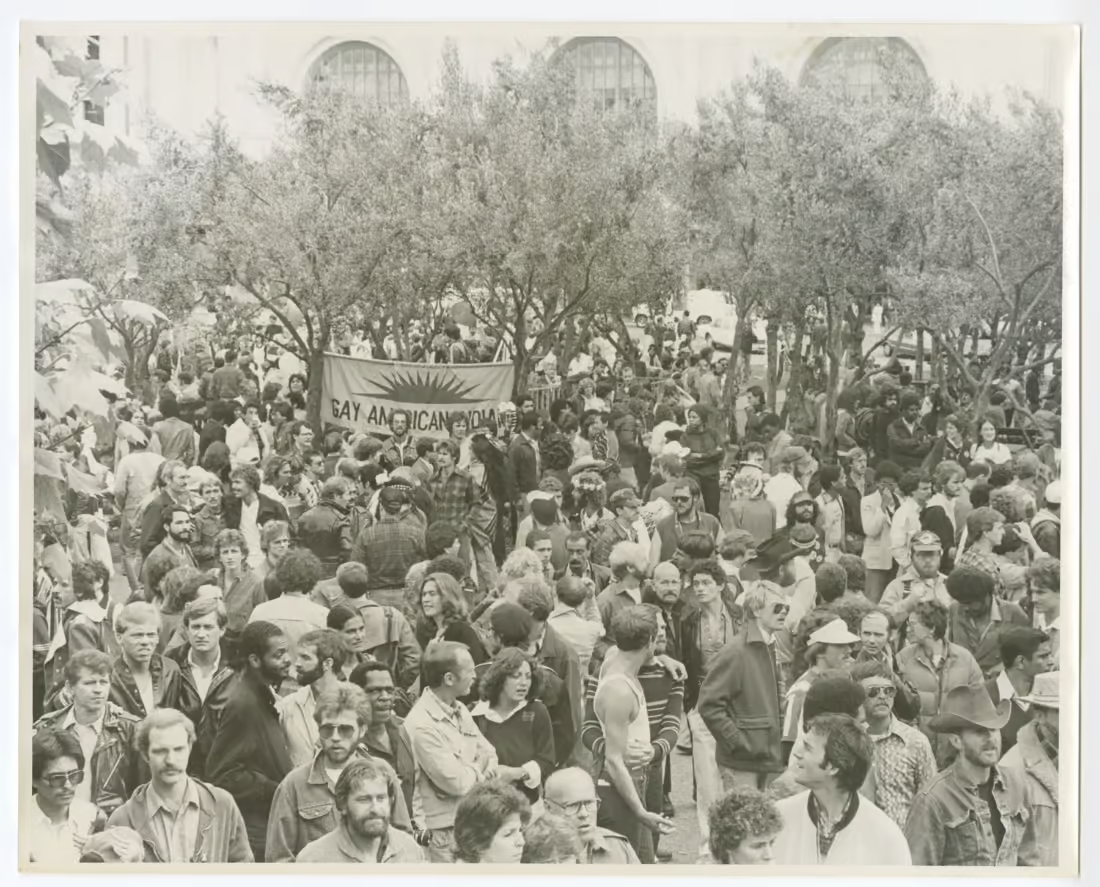
This photograph captures members of Gay American Indians (GAI) marching with their banner at the San Francisco Gay Freedom Day Parade on June 24, 1979. At a time when both Indigenous presence and Two-Spirit identities were largely invisible within mainstream LGBTQ+ movements, GAI’s participation marked a powerful act of visibility and self-representation.
By carrying their name publicly through the streets of San Francisco, GAI asserted that Indigenous LGBTQ+ people were not only present but also organized, political, and grounded in their own community formations. The banner itself functioned as more than identification—it was a declaration of sovereignty within queer public space, challenging both the erasure of Indigenous peoples in urban settings and the marginalization of Native voices within gay liberation movements.
This moment reflects an early stage of GAI’s transition from a support network into a visible political collective. Their presence in the parade situates Two-Spirit and Indigenous LGBTQ+ histories within broader movements for liberation, while also signalling the need for distinct spaces and language grounded in Indigenous self-determination.
As preserved in the GLBT Historical Society’s archives, this image stands as a record of early Two-Spirit visibility in public space—one that continues to resonate in ongoing efforts to assert Indigenous presence within both historical narratives and contemporary queer communities.
Photo from June 24, 1979; Gay American Indians banner at Civic Center during San Francisco “Gay Freedom Day Parade”. Photo by Joe Altman.
Regeneration Notes